

Zero-waste pattern cutting
Zero-waste pattern cutting is the dark art of making clothing patterns that fill the entire piece of fabric.
“Normal” patterns typically have numerous curves and shapes that leave scraps of fabric behind after being cut out. Zero-waste patterns are carefully engineered to use every last scrap of fabric.
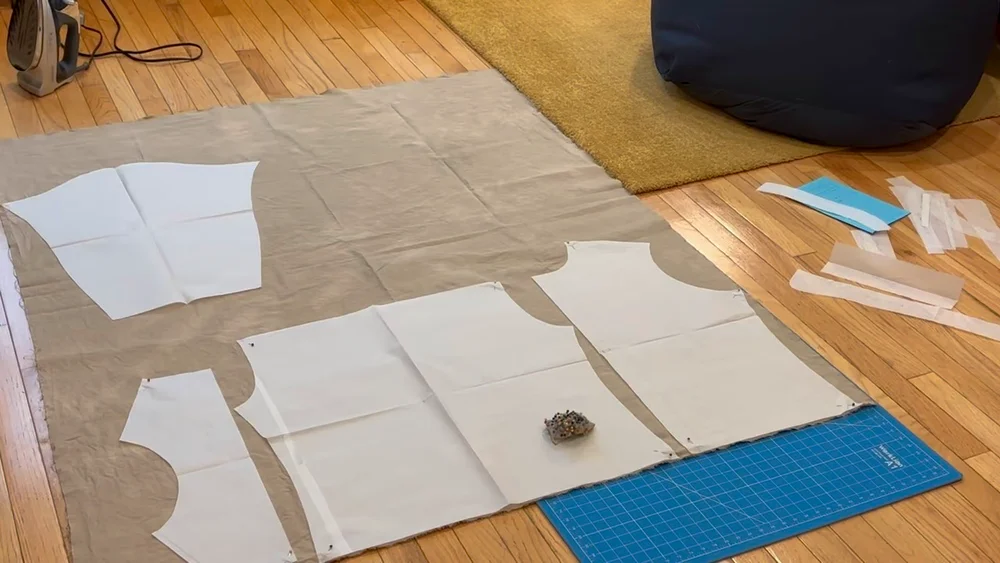 A typical pattern—note the scraps around the curves
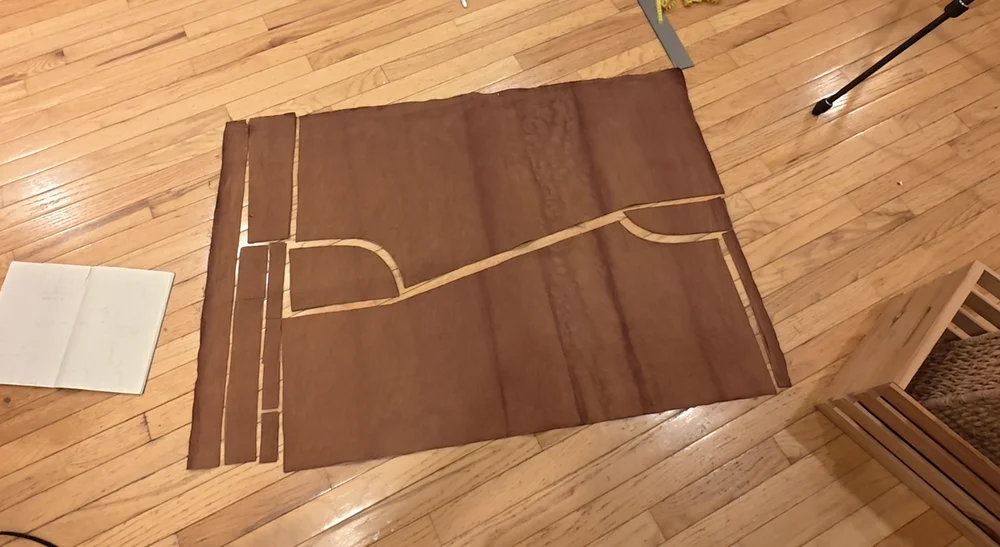 A zero waste pants pattern
I learned a lot about zero-waste patterns from these resources:
Birgitta Helmersson’s book on Zero-Waste Patterns
Liz Haywood’s blog
Isaboko (the original inspiration for me)
I was originally drawn to this technique because it seemed like a clever way to make clothes more sustainable. But there is actually a very interesting historical analysis. And it starts with the question:
Won’t everything just look boxy?
No, not necessarily … ? But also yeah? But also it depends on your point of view?
Don’t knock it till you’ve tried it (I have, so I can knock it)
“Zero waste patternmaking gives boxy, ill-fitting clothes” is such a common critique of this technique. And it’s not necessarily wrong: square pieces naturally will give (saggy) square shapes on the body. However, there are examples of extremely intricate and clever contemporary zero waste patterns that are very much NOT square at all.
That being said, if you’re looking to turn the kind of pattern and/or construction techniques that are standard at this point in history into a zero-waste approach, you will find that it is quite challenging to get something that fits amazing and looks “normal” (whatever the hell “normal” means…). And that’s because a lot of variables that usually exist independent of one another are suddenly coupled to 1. the boundaries of the cloth you have and 2. other variables, due to the need to tile every pattern piece completely onto that area of cloth. For example, you might find that in order to be zero-waste, the length of the crotch curve on a pair of pants is directly connected to the size of the pant’s pockets! It gets really confusing and complicated, and creative tradeoffs need to be made. But that leads to interesting designs!
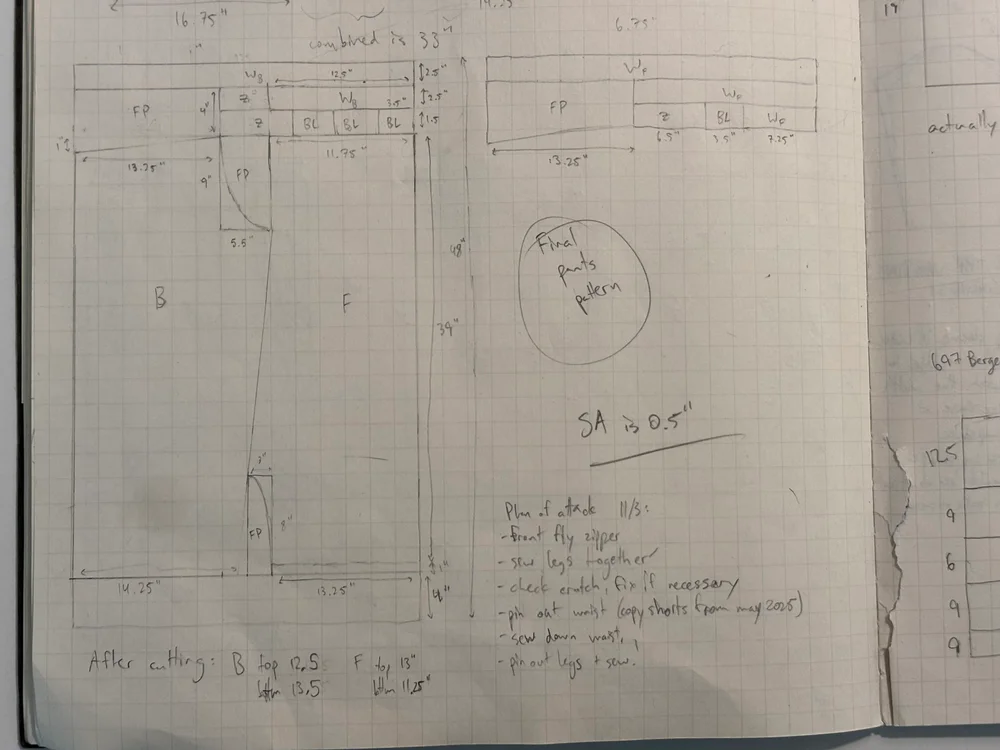 “FP” stands for front pocket—the space left by the crotch curve is turned into a pocket. Note how the other front pocket is a different shape entirely (there are accidentally three front pockets in this pattern). This is the pattern for the pants of my last outfit.
Another point often made while criticizing zero-waste patternmaking is that it’s far better to have clothes that fit you well and treasure them until they disintegrate, than have ill-fitting clothes that you don’t love and never wear. This is a strong point on its own, but it assumes that we don’t already live in a world where most of our clothes are ill-fitting and languishing in the backs of our closets, and that zero-waste clothes never fit.
I think the criticism comes from a reaction to the feeling that zero-waste patternmaking is somehow “holier-than-thou.” Sustainability-forward messaging does have a bad smell these days. While I was first drawn to this technique because of the sustainability of it all, it’s evolved into a fun design challenge, a constraint to drive creativity in my patterns. Plus, zero-waste patternmaking has a very long history.
The history of zero-waste patternmaking
Many, many, many traditional forms of dress from around the world use zero-waste pattern cutting techniques, because it was historically so much work to create fabric. Kimonos are one example of this: https://isaboko.com/pages/guidebook-vol-1 (scroll down a bit to see the zero-waste pattern).
I watched an interesting video on how a Western versus Chinese tailor would make the same shirt, and what that says about what the different cultures value: https://www.instagram.com/p/DWVtDtbE57k/. The Chinese approach is much more zero-waste—they are trying to maximize the usage of the fabric, because they value the beauty of the fabric over the shape of the body wearing it. By leaving cuts and wastage to a minimum, they are foregrounding the beauty of the textile and the collective efforts that went into making the fabric. Western patternmaking techniques prioritize cutting clothing to conform to the shape of the body. The individual wearing the garment is the primary concern.
So really, how you cut clothing is a question of what you value.
I’ll probably make a video about this.